Cheating statistics 2026: how common it is, and what phones changed
About 1 in 5 ever-married American men (20%) and 1 in 8 women (13%) say they have had sex with someone other than their spouse, and a third of Americans who have been in a monogamous relationship say they have cheated in some way.
This page collects more than 130 statistics on cheating and infidelity, with a focus on what phones, social media and dating apps changed. Every number links to its original source: Pew Research Center, YouGov, Gallup, the General Social Survey, peer-reviewed studies, the FBI, the FTC and the CDC. We don’t publish figures we couldn’t trace to the original.
Key statistics
- 20% of ever-married men and 13% of ever-married women in the US say they have had sex with someone other than their spouse while married. (Source: Institute for Family Studies (General Social Survey), 2018)
- 33% of Americans who have ever been in a monogamous relationship say they have cheated on a partner, physically, emotionally or both. (Source: YouGov, 2022)
- 82% of Britons say sending nudes to someone else is cheating and 80% say using dating apps is, but only 26% say flirting is. (Source: YouGov, 2026)
- Emotional cheating is now as common as sexual cheating: 18% of Britons who have been in a relationship admit emotional cheating, 17% sexual cheating and 12% both. (Source: YouGov, 2026)
- 23% of partnered US adults whose partner uses social media have felt jealous or unsure about their relationship because of how their partner interacts with other people there. (Source: Pew Research Center, 2020)
- 34% of partnered US adults have looked through their partner’s cellphone without that person’s knowledge. (Source: Pew Research Center, 2020)
- 53% of US social media users have used social media to check up on someone they used to date or be in a relationship with. (Source: Pew Research Center, 2020)
- 11% of married Americans under 40 say they are currently using dating apps or websites. (Source: Institute for Family Studies / YouGov, 2025)
- Only 8% of Americans say it is morally acceptable for married men and women to have an affair; 89% say it is morally wrong. (Source: Gallup, 2025)
- Nearly 60% of people who reported losing money to a romance scam in 2025 said it started on a social media platform. (Source: Federal Trade Commission, 2026)
How common is cheating?
20% of ever-married men and 13% of ever-married women in the US say they have had sex with someone other than their spouse while married. (Source: Institute for Family Studies (General Social Survey), 2018)
Estimates depend on what is counted. The General Social Survey asks only about sex outside marriage; YouGov also counts emotional cheating and unmarried couples, which gives higher numbers.
- # 20% of ever-married men and 13% of ever-married women in the US say they have had sex with someone other than their spouse while married. (Source: Institute for Family Studies (General Social Survey), 2018; ever-married US adults)
- # Among ever-married adults aged 18–29, women are slightly more likely than men to report infidelity (11% vs 10%). (Source: Institute for Family Studies (General Social Survey), 2018; ever-married US adults)
- # Men in their 70s report the highest infidelity rate of any age group (26%); among women, those in their 60s do (16%). (Source: Institute for Family Studies (General Social Survey), 2018; ever-married US adults)
- # The share of ever-married Americans aged 25–54 who say they have cheated fell from 17% in 1991–98 to 14% in 2010–18 and 13% in 2021–22. (Source: Institute for Family Studies (General Social Survey), 2025; ever-married US adults aged 25–54)
- # In 2016, 20% of ever-married Americans over 55 reported extramarital sex, compared with 14% of those under 55. (Source: Institute for Family Studies (General Social Survey), 2017; ever-married US adults)
- # 33% of Americans who have ever been in a monogamous relationship say they have cheated on a partner, physically, emotionally or both. (Source: YouGov, 2022; 2,000 US adults, Sep 2022)
- # 54% of Americans who have been in a monogamous relationship say they have been cheated on. (Source: YouGov, 2022; 2,000 US adults, Sep 2022)
- # Admitting to cheating on a current partner varies by relationship type: 13% of married people, 26% of people living together and 36% of people in casual relationships. (Source: YouGov, 2022; 2,000 US adults, Sep 2022)
- # 25% of Americans say they have engaged in sexual activities with someone else without their partner’s consent: 29% of men and 21% of women. (Source: YouGov, 2025; 1,125 US adults, Apr 2025)
- # 23% of Britons who have ever been in a relationship admit to having cheated on a partner. (Source: YouGov, 2026; 1,882 British adults, Jul 2026)
- # 46% of American women and 34% of American men say a partner has cheated on them. (Source: Survey Center on American Life, 2025; US adults, 2023 survey)
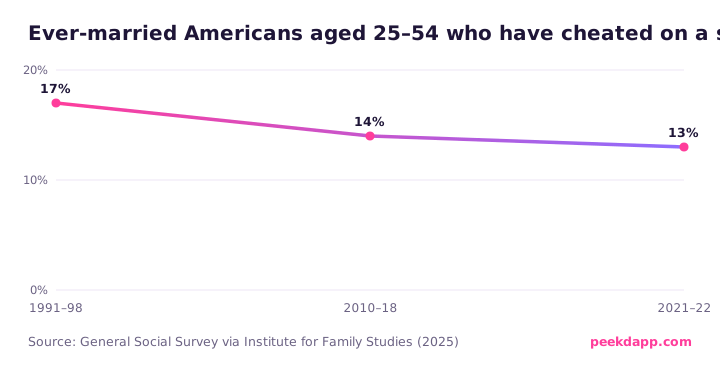
Chart data and embed code
| Value | |
|---|---|
| 1991–98 | 17% |
| 2010–18 | 14% |
| 2021–22 | 13% |
<a href="https://www.peekdapp.com/cheating-statistics/#chart-cheating-trend"><img src="https://www.peekdapp.com/assets/stats/cheating-statistics/cheating-trend.svg" alt="Ever-married Americans aged 25–54 who have cheated on a spouse" width="720" height="368" style="max-width:100%;height:auto" /></a>
<p>Source: <a href="https://www.peekdapp.com/cheating-statistics/">Cheating Statistics 2026: Infidelity, Phones and Social Media</a> (Peekd)</p>What counts as cheating in 2026
82% of Britons say sending nudes to someone else is cheating and 80% say using dating apps is, but only 26% say flirting is. (Source: YouGov, 2026)
Almost everyone agrees that sex with someone else is cheating. Below that line, opinions split, often along gender lines, and digital behaviour like sending nudes or using dating apps now ranks close to physical acts.
- # 94% of Britons say having sex with someone else counts as cheating. (Source: YouGov, 2026; 1,882 British adults, Jul 2026)
- # 82% of Britons say sending nudes to someone else is cheating and 80% say using dating apps is, but only 26% say flirting is. (Source: YouGov, 2026; 1,882 British adults, Jul 2026)
- # 73% of Britons say kissing someone else is cheating. (Source: YouGov, 2026; 1,882 British adults, Jul 2026)
- # 69% of Britons say secretly messaging or meeting up with an ex is cheating. (Source: YouGov, 2026; 1,882 British adults, Jul 2026)
- # 52% of Britons say a deep emotional attachment to someone else is cheating: 60% of women but only 43% of men. (Source: YouGov, 2026; 1,882 British adults, Jul 2026)
- # 47% of Britons count subscribing to OnlyFans creators as cheating (57% of women vs 37% of men). (Source: YouGov, 2026; 1,882 British adults, Jul 2026)
- # 40% of Britons say having romantic feelings for someone else is cheating. (Source: YouGov, 2026; 1,882 British adults, Jul 2026)
- # 30% of Britons say sexting with an AI is cheating (38% of women vs 22% of men). (Source: YouGov, 2026; 1,882 British adults, Jul 2026)
- # Only 16% of Britons say fantasising about someone else is cheating, and 15% say having a crush is. (Source: YouGov, 2026; 1,882 British adults, Jul 2026)
- # 9 in 10 Americans say having sex with another person or sending them nude photos is cheating. (Source: YouGov, 2022; 2,000 US adults, Sep 2022)
- # 83% of Americans say sending suggestive messages to someone else is cheating, 80% say lying about time spent with someone is, and 73% say an intense emotional attachment is. (Source: YouGov, 2022; 2,000 US adults, Sep 2022)
- # 23% of Americans count all ten behaviours YouGov asked about as cheating. (Source: YouGov, 2022; 2,000 US adults, Sep 2022)
- # 16% of Americans say following an ex on social media is always cheating, and 45% say it sometimes is. (Source: Deseret News / YouGov, 2017; 1,250 US adults)
- # 63% of Americans say keeping an online dating profile while in a relationship is always cheating: 70% of women and 55% of men. (Source: Deseret News / YouGov, 2017; 1,250 US adults)
- # 59% of American women but 42% of men say sending flirtatious messages to someone other than your partner is always cheating. (Source: Deseret News / YouGov, 2017; 1,250 US adults)
- # 32% of Americans count following an old flame online as infidelity, and 42% count flirting. (Source: Institute for Family Studies / YouGov, 2024; 2,000 US adults, 2019)
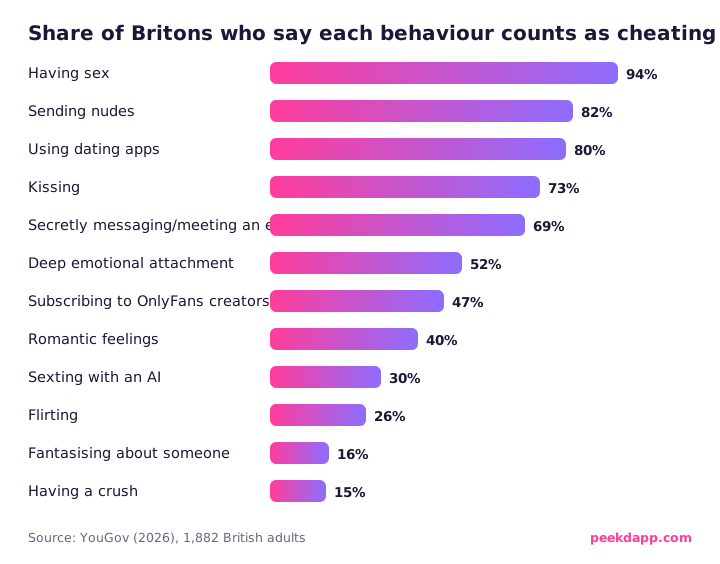
Chart data and embed code
| Value | |
|---|---|
| Having sex | 94% |
| Sending nudes | 82% |
| Using dating apps | 80% |
| Kissing | 73% |
| Secretly messaging/meeting an ex | 69% |
| Deep emotional attachment | 52% |
| Subscribing to OnlyFans creators | 47% |
| Romantic feelings | 40% |
| Sexting with an AI | 30% |
| Flirting | 26% |
| Fantasising about someone | 16% |
| Having a crush | 15% |
<a href="https://www.peekdapp.com/cheating-statistics/#chart-what-counts"><img src="https://www.peekdapp.com/assets/stats/cheating-statistics/what-counts.svg" alt="Share of Britons who say each behaviour counts as cheating" width="720" height="564" style="max-width:100%;height:auto" /></a>
<p>Source: <a href="https://www.peekdapp.com/cheating-statistics/">Cheating Statistics 2026: Infidelity, Phones and Social Media</a> (Peekd)</p>Emotional cheating and micro-cheating
Emotional cheating is now as common as sexual cheating: 18% of Britons who have been in a relationship admit emotional cheating, 17% sexual cheating and 12% both. (Source: YouGov, 2026)
Emotional affairs are now about as common as sexual ones, and many smaller, often secret behaviours, sometimes called micro-cheating, are seen as cheating by a sizeable minority.
- # Emotional cheating is now as common as sexual cheating: 18% of Britons who have been in a relationship admit emotional cheating, 17% sexual cheating and 12% both. (Source: YouGov, 2026; 1,882 British adults, Jul 2026)
- # Asked which would be worse, 40% of Britons pick a partner having a sex-only affair and 25% an emotional-only affair. (Source: YouGov, 2026; 1,882 British adults, Jul 2026)
- # Men are far more likely to see a sex-only affair as worse (46% vs 20% for an emotional affair); women are more evenly split (35% vs 29%). (Source: YouGov, 2026; 1,882 British adults, Jul 2026)
- # When “both equally bad” is an option, 68% of Britons choose it; 11% say a sexual affair is worse and 7% an emotional one. (Source: YouGov, 2020; 4,133 British adults)
- # 7% of ever-married Americans have had a strictly emotional affair, 5% a sexual-only affair and 10% both; 78% report neither. (Source: Institute for Family Studies / YouGov, 2024; 2,000 US adults, 2019)
- # Women make up 56% of Americans reporting emotional-only affairs, while men make up 75% of those reporting sexual-only affairs. (Source: Institute for Family Studies / YouGov, 2024; 2,000 US adults, 2019)
- # 76% of Americans say a married person having a secret emotional relationship in real life is a form of infidelity; 72% say the same of one that happens online. (Source: Institute for Family Studies / YouGov, 2024; 2,000 US adults, 2019)
- # 41% of Americans say ongoing flirtatious texting with someone else is cheating, and 40% say hiding late-night conversations is. (Source: Talker Research, 2026; 2,000 US adults; commercial poll)
- # 37% of Americans count keeping someone in your phone under a fake name as cheating, and 37% count keeping a dating profile “just to look”. (Source: Talker Research, 2026; 2,000 US adults; commercial poll)
- # 36% of Americans count deleting messages so a partner won’t see them as cheating, and 36% count secret contact with an ex. (Source: Talker Research, 2026; 2,000 US adults; commercial poll)
- # 33% of Americans say having a “work spouse” is cheating. (Source: Talker Research, 2026; 2,000 US adults; commercial poll)
- # 27% of Americans say keeping an Instagram Close Friends list that leaves your partner out is cheating. (Source: Talker Research, 2026; 2,000 US adults; commercial poll)
- # 1 in 10 Americans admit deleting messages so their partner won’t see them. (Source: Talker Research, 2026; 2,000 US adults; commercial poll)
- # 15% of partnered Americans have romantic feelings for someone else, rising to 31% of Gen Z. (Source: Talker Research, 2026; 2,000 US adults; commercial poll)
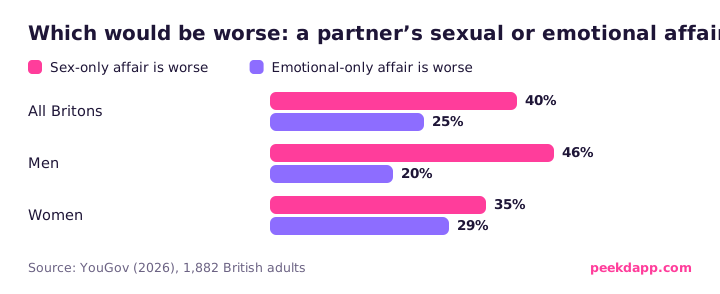
Chart data and embed code
| Sex-only affair is worse | Emotional-only affair is worse | |
|---|---|---|
| All Britons | 40% | 25% |
| Men | 46% | 20% |
| Women | 35% | 29% |
<a href="https://www.peekdapp.com/cheating-statistics/#chart-which-is-worse"><img src="https://www.peekdapp.com/assets/stats/cheating-statistics/which-is-worse.svg" alt="Which would be worse: a partner’s sexual or emotional affair?" width="720" height="294" style="max-width:100%;height:auto" /></a>
<p>Source: <a href="https://www.peekdapp.com/cheating-statistics/">Cheating Statistics 2026: Infidelity, Phones and Social Media</a> (Peekd)</p>Checking a partner’s phone
34% of partnered US adults have looked through their partner’s cellphone without that person’s knowledge. (Source: Pew Research Center, 2020)
Most people say snooping on a partner’s phone is wrong, and a third of partnered adults have done it anyway. Password sharing is common, which makes it easy.
- # 34% of partnered US adults have looked through their partner’s cellphone without that person’s knowledge. (Source: Pew Research Center, 2020; 4,860 US adults, Oct 2019)
- # Partnered women are more likely than men to have looked through a partner’s phone without them knowing (42% vs 25%). (Source: Pew Research Center, 2020; 4,860 US adults, Oct 2019)
- # 52% of partnered adults aged 18–29 have looked through a partner’s phone without them knowing, compared with 41% of 30–49s, 29% of 50–64s and 13% of those 65 and older. (Source: Pew Research Center, 2020; 4,860 US adults, Oct 2019)
- # 70% of US adults say it is rarely (28%) or never (42%) acceptable to look through a significant other’s cellphone without their knowledge. (Source: Pew Research Center, 2020; 4,860 US adults, Oct 2019)
- # 75% of partnered adults have given their partner the password to their cellphone, 62% to their email and 42% to at least one social media account. (Source: Pew Research Center, 2020; 4,860 US adults, Oct 2019)
- # 46% of Americans admit to “stalking” an ex or current partner online. (Source: NortonLifeLock / The Harris Poll, 2020; 2,050 US adults)
- # 29% of Americans say they have checked a current or former partner’s phone. (Source: NortonLifeLock / The Harris Poll, 2020; 2,050 US adults)
- # 21% of Americans have looked through a partner’s search history on one of their devices, and 10% have used an app to monitor a partner’s texts. (Source: NortonLifeLock / The Harris Poll, 2020; 2,050 US adults)
- # 34% of people in 10 countries who have been in a romantic relationship admit checking on a current or former partner online without their knowledge or consent; in the US it is 37%. (Source: NortonLifeLock / The Harris Poll, 2021; 10,030 adults in 10 countries)
- # 15% of US adults in a relationship read their partner’s text messages and social media without permission every day. (Source: YouGov, 2017; US adults in a relationship)
- # 30% of people across 21 countries see no problem with secretly monitoring a partner in some circumstances. (Source: Kaspersky, 2021; 21,000+ adults in 21 countries)
- # 15% of people worldwide say a partner has required them to install a monitoring app. (Source: Kaspersky, 2021; 21,000+ adults in 21 countries)
- # Just under half of married Britons admit secretly checking their partner’s Facebook account, and 14% did so looking for evidence of infidelity. (Source: Slater and Gordon, 2015; 2,000 married UK adults)
- # 85% of Americans in committed relationships give their partner access to their personal accounts. (Source: Malwarebytes, 2024; 500 US adults in relationships)
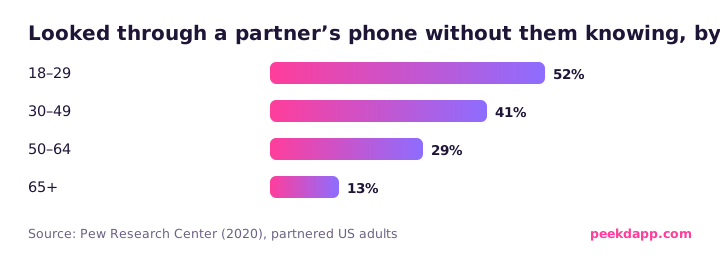
Chart data and embed code
| Value | |
|---|---|
| 18–29 | 52% |
| 30–49 | 41% |
| 50–64 | 29% |
| 65+ | 13% |
<a href="https://www.peekdapp.com/cheating-statistics/#chart-phone-by-age"><img src="https://www.peekdapp.com/assets/stats/cheating-statistics/phone-by-age.svg" alt="Looked through a partner’s phone without them knowing, by age" width="720" height="260" style="max-width:100%;height:auto" /></a>
<p>Source: <a href="https://www.peekdapp.com/cheating-statistics/">Cheating Statistics 2026: Infidelity, Phones and Social Media</a> (Peekd)</p>Keeping tabs on exes online
53% of US social media users have used social media to check up on someone they used to date or be in a relationship with. (Source: Pew Research Center, 2020)
Checking up on a former partner has become normal, especially for people under 30. The share has grown as social media use has.
- # 53% of US social media users have used social media to check up on someone they used to date or be in a relationship with. (Source: Pew Research Center, 2020; 4,860 US adults, Oct 2019)
- # Among social media users under 30, 70% have used social media to check up on a former partner. (Source: Pew Research Center, 2020; 4,860 US adults, Oct 2019)
- # Single social media users (56%) are more likely than married ones (45%) to have checked up on an ex; about two-thirds of people who live with a partner or are in a committed relationship have. (Source: Pew Research Center, 2020; 4,860 US adults, Oct 2019)
- # 28% of partnered social media users say social media is important for keeping up with what is going on in their partner’s life, and 33% say it is important for showing how much they care. (Source: Pew Research Center, 2020; 4,860 US adults, Oct 2019)
- # In 2013, 31% of social networking site users had gone online to check up on someone they used to date. (Source: Pew Research Center, 2013; US social networking site users)
- # In 2013, 22% of social networking site users had unfriended or blocked someone they were once in a relationship with, and 17% had untagged or deleted photos of themselves with an ex. (Source: Pew Research Center, 2013; US social networking site users)
- # 25% of Americans say they would unfollow an ex on social media after a breakup. (Source: YouGov, 2022; 1,000 US adults)
- # 9% of Americans say they have created a fake social media profile to check on a current or former partner. (Source: NortonLifeLock / The Harris Poll, 2020; 2,050 US adults)
- # 41% of people surveyed across 21 countries have googled or checked the social media of someone they had just started dating, and 34% think doing so is acceptable. (Source: Kaspersky, 2024; 21,000 people in 21 countries)
- # 23% have experienced some form of online stalking from a person they had recently started dating. (Source: Kaspersky, 2024; 21,000 people in 21 countries)
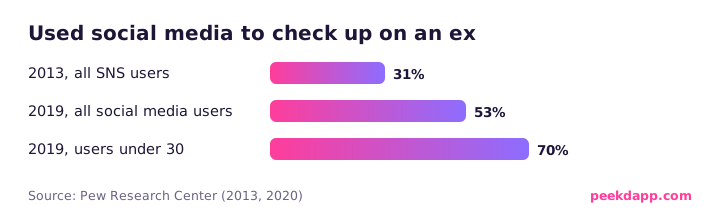
Chart data and embed code
| Value | |
|---|---|
| 2013, all SNS users | 31% |
| 2019, all social media users | 53% |
| 2019, users under 30 | 70% |
<a href="https://www.peekdapp.com/cheating-statistics/#chart-exes-then-now"><img src="https://www.peekdapp.com/assets/stats/cheating-statistics/exes-then-now.svg" alt="Used social media to check up on an ex" width="720" height="222" style="max-width:100%;height:auto" /></a>
<p>Source: <a href="https://www.peekdapp.com/cheating-statistics/">Cheating Statistics 2026: Infidelity, Phones and Social Media</a> (Peekd)</p>Dating apps and people in relationships
11% of married Americans under 40 say they are currently using dating apps or websites. (Source: Institute for Family Studies / YouGov, 2025)
Dating apps are not only used by singles. Reliable figures are scarce, so we list only surveys and studies we could trace; the widely repeated claim that “30% of Tinder users are married” comes from a 2015 analysis that is no longer online and that Tinder disputed, so it is not included.
- # 11% of married Americans under 40 say they are currently using dating apps or websites. (Source: Institute for Family Studies / YouGov, 2025; 2,000 US adults aged 18–39)
- # 18% of married men under 40 are currently on a dating app or site, three times the share of married women (6%). (Source: Institute for Family Studies / YouGov, 2025; 2,000 US adults aged 18–39)
- # 24% of dating-app users under 40 are married. (Source: Institute for Family Studies / YouGov, 2025; 2,000 US adults aged 18–39)
- # In a study of 1,486 Tinder users, 22.4% were using the app while in a committed relationship. (Source: Timmermans et al., Computers in Human Behavior (via PsyPost), 2018; 1,486 Tinder users)
- # In a study of US college students who had used Tinder, 17.1% had messaged someone on the app while in an exclusive relationship, and 7.2% had had sex with someone they met on it while in one. (Source: Weiser et al., Personality and Individual Differences (via Texas Tech), 2018; 550 US college students)
- # In the same study, 12.5% had met up with a Tinder match while in an exclusive relationship, and 8.9% had been physically intimate with one. (Source: Weiser et al., Personality and Individual Differences (via Texas Tech), 2018; 550 US college students)
- # 30% of US adults have ever used a dating site or app, including 16% of married adults. (Source: Pew Research Center, 2023; 6,034 US adults, Jul 2022)
- # 10% of partnered US adults met their current spouse or partner on a dating site or app. (Source: Pew Research Center, 2023; 6,034 US adults, Jul 2022)
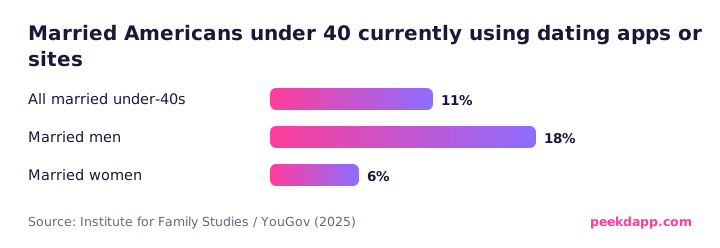
Chart data and embed code
| Value | |
|---|---|
| All married under-40s | 11% |
| Married men | 18% |
| Married women | 6% |
<a href="https://www.peekdapp.com/cheating-statistics/#chart-married-on-apps"><img src="https://www.peekdapp.com/assets/stats/cheating-statistics/married-on-apps.svg" alt="Married Americans under 40 currently using dating apps or sites" width="720" height="248" style="max-width:100%;height:auto" /></a>
<p>Source: <a href="https://www.peekdapp.com/cheating-statistics/">Cheating Statistics 2026: Infidelity, Phones and Social Media</a> (Peekd)</p>Ghosting and breadcrumbing
About 1 in 3 young adults (35.6%) were breadcrumbed in the past year and nearly 1 in 5 (19.3%) were ghosted, in a peer-reviewed study of 18- to 40-year-olds. (Source: Navarro et al., Escritos de Psicología, 2020)
Ghosting means ending contact without explanation. Breadcrumbing means sending just enough messages to keep someone interested without committing. Orbiting means going silent but still watching someone’s stories and posts.
- # In the same study, 23.2% had ghosted someone in the past year and 36.7% had breadcrumbed someone. (Source: Navarro et al., Escritos de Psicología, 2020; 626 adults aged 18–40, Spain)
- # 63.6% of participants didn’t know the term “ghosting” and 86.1% didn’t know “breadcrumbing”, even though many had experienced both. (Source: Navarro et al., Escritos de Psicología, 2020; 626 adults aged 18–40, Spain)
- # 30% of US adults say they have ghosted someone. (Source: YouGov, 2019; 1,782 US adults)
- # 19% of Americans have been ghosted by someone they were dating, and 17% have ghosted someone they were dating. (Source: YouGov, 2021; 7,180 US adults)
- # In an experiment with 176 adults, being ghosted led to worse outcomes than being openly rejected, with orbiting falling in between. (Source: Pancani, Aureli & Riva, Cyberpsychology, 2022; 176 adults, experiment)
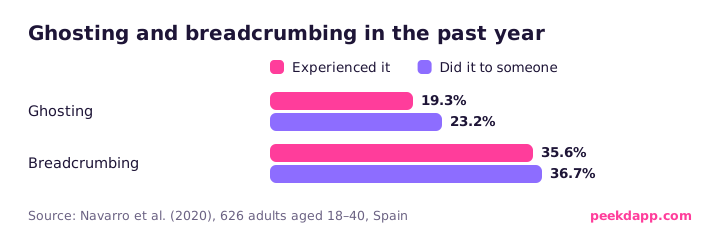
Chart data and embed code
| Experienced it | Did it to someone | |
|---|---|---|
| Ghosting | 19.3% | 23.2% |
| Breadcrumbing | 35.6% | 36.7% |
<a href="https://www.peekdapp.com/cheating-statistics/#chart-ghosting"><img src="https://www.peekdapp.com/assets/stats/cheating-statistics/ghosting.svg" alt="Ghosting and breadcrumbing in the past year" width="720" height="242" style="max-width:100%;height:auto" /></a>
<p>Source: <a href="https://www.peekdapp.com/cheating-statistics/">Cheating Statistics 2026: Infidelity, Phones and Social Media</a> (Peekd)</p>Social media and divorce
97% of top US divorce lawyers have seen an increase in divorce evidence taken from smartphones. (Source: American Academy of Matrimonial Lawyers, 2015)
Divorce lawyers saw social media become a routine source of evidence. The most recent survey of the American Academy of Matrimonial Lawyers on this is from 2015. Claims that “a third of divorces mention Facebook” come from one firm counting the word in its own filings and are not included.
- # 97% of top US divorce lawyers have seen an increase in divorce evidence taken from smartphones. (Source: American Academy of Matrimonial Lawyers, 2015; AAML members)
- # 67% of US divorce lawyers have seen more evidence from apps; the most-cited were Facebook (41%), Twitter (17%) and Instagram (16%). (Source: American Academy of Matrimonial Lawyers, 2015; AAML members)
- # 81% of US divorce lawyers reported an increase in evidence from social networking sites over the previous five years. (Source: American Academy of Matrimonial Lawyers, 2010; AAML members)
- # In 2010, 66% of US divorce lawyers named Facebook as the primary source of social networking evidence, ahead of MySpace (15%) and Twitter (5%). (Source: American Academy of Matrimonial Lawyers, 2010; AAML members)
- # 1 in 7 married Britons have contemplated divorce because of their partner’s activity on social media or messaging apps. (Source: Slater and Gordon, 2015; 2,000 married UK adults)
- # A 20% increase in Facebook users in a US state was linked to a 2.18% rise in its divorce rate; the authors caution that this is not proof that Facebook causes divorce. (Source: Valenzuela, Halpern & Katz, Computers in Human Behavior (via Boston University), 2014; 43 US states; 1,160 married adults)
- # In the same study, 32% of married heavy social media users had thought about leaving their spouse, compared with 16% of non-users. (Source: Valenzuela, Halpern & Katz, Computers in Human Behavior (via Boston University), 2014; 43 US states; 1,160 married adults)
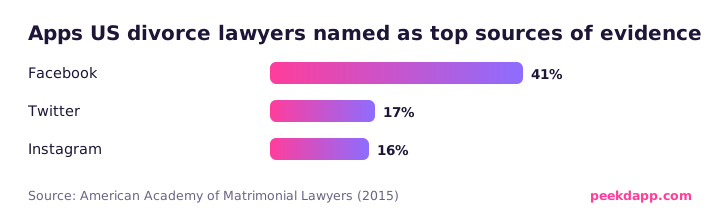
Chart data and embed code
| Value | |
|---|---|
| 41% | |
| 17% | |
| 16% |
<a href="https://www.peekdapp.com/cheating-statistics/#chart-divorce-evidence-apps"><img src="https://www.peekdapp.com/assets/stats/cheating-statistics/divorce-evidence-apps.svg" alt="Apps US divorce lawyers named as top sources of evidence" width="720" height="222" style="max-width:100%;height:auto" /></a>
<p>Source: <a href="https://www.peekdapp.com/cheating-statistics/">Cheating Statistics 2026: Infidelity, Phones and Social Media</a> (Peekd)</p>What happens after cheating
Only 8% of Americans say it is morally acceptable for married men and women to have an affair; 89% say it is morally wrong. (Source: Gallup, 2025)
Attitudes to affairs have barely moved in 25 years. Cheating is strongly linked to divorce, but many couples stay together or reunite.
- # Only 8% of Americans say it is morally acceptable for married men and women to have an affair; 89% say it is morally wrong. (Source: Gallup, 2025; 1,003 US adults, May 2025)
- # Since 2001, the share of Americans calling affairs morally acceptable has stayed between 4% and 12% every year. (Source: Gallup, 2025; 1,003 US adults, May 2025)
- # 52% of ever-married Americans aged 25–54 who have cheated are currently divorced or separated, compared with 15% of those who haven’t cheated. (Source: Institute for Family Studies (General Social Survey), 2025; ever-married US adults aged 25–54)
- # About 60% of women aged 25–54 who cheated on a spouse are divorced or separated, compared with 45% of men who did. (Source: Institute for Family Studies (General Social Survey), 2025; ever-married US adults aged 25–54)
- # Across all ages, 40% of ever-married Americans who have cheated on a spouse are divorced or separated, compared with 17% of those who have been faithful. (Source: Institute for Family Studies (General Social Survey), 2018; ever-married US adults)
- # More than half of men and women who have extramarital sex also separate from or divorce their spouse. (Source: Allen & Atkins, Journal of Family Issues, 2012; 16,090 US adults (GSS))
- # In a study of divorced adults, 59.6% named infidelity as a major reason for their divorce, and at least one partner named it in 88.8% of couples. (Source: Scott et al., Couple and Family Psychology, 2013; 52 divorced adults)
- # Infidelity was the most common “final straw” before divorce, named by 24% of those who had one, ahead of domestic violence (21.2%) and substance abuse (12.1%). (Source: Scott et al., Couple and Family Psychology, 2013; 52 divorced adults)
- # 67% of Americans who have cheated on a partner were not broken up with by that partner. (Source: YouGov, 2022; 2,000 US adults, Sep 2022)
- # About 3 in 4 Americans who were cheated on broke up with the partner who cheated, and 39% of them later got back together. (Source: YouGov, 2022; 2,000 US adults, Sep 2022)
- # 4 in 5 Americans who were cheated on say they are glad they found out. (Source: YouGov, 2022; 2,000 US adults, Sep 2022)
- # Five years after couple therapy, 80% of couples where an affair stayed secret had divorced, compared with 43% where it was revealed and 23% with no affair (a small sample). (Source: Marín, Christensen & Atkins, Couple and Family Psychology, 2014; 134 couples in therapy)
- # 37% of Britons say there are circumstances where it is reasonable to take back a partner who cheated; 41% say never. (Source: YouGov, 2026; 1,882 British adults, Jul 2026)
- # Across 40 countries, a median of 78% say affairs are morally unacceptable; in France only 47% do. (Source: Pew Research Center, 2014; 40 countries)
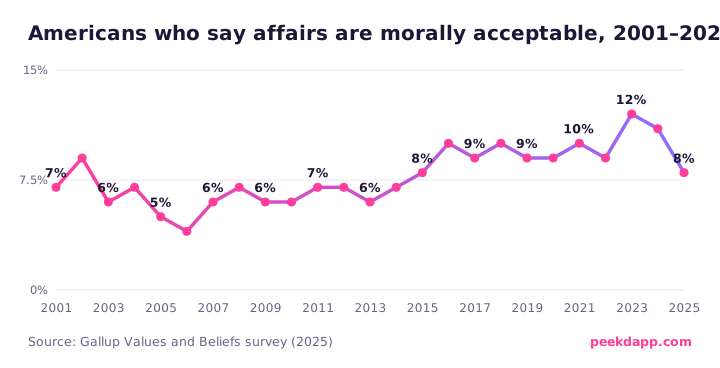
Chart data and embed code
| Value | |
|---|---|
| 2001 | 7% |
| 2002 | 9% |
| 2003 | 6% |
| 2004 | 7% |
| 2005 | 5% |
| 2006 | 4% |
| 2007 | 6% |
| 2008 | 7% |
| 2009 | 6% |
| 2010 | 6% |
| 2011 | 7% |
| 2012 | 7% |
| 2013 | 6% |
| 2014 | 7% |
| 2015 | 8% |
| 2016 | 10% |
| 2017 | 9% |
| 2018 | 10% |
| 2019 | 9% |
| 2020 | 9% |
| 2021 | 10% |
| 2022 | 9% |
| 2023 | 12% |
| 2024 | 11% |
| 2025 | 8% |
<a href="https://www.peekdapp.com/cheating-statistics/#chart-affairs-acceptable"><img src="https://www.peekdapp.com/assets/stats/cheating-statistics/affairs-acceptable.svg" alt="Americans who say affairs are morally acceptable, 2001–2025" width="720" height="368" style="max-width:100%;height:auto" /></a>
<p>Source: <a href="https://www.peekdapp.com/cheating-statistics/">Cheating Statistics 2026: Infidelity, Phones and Social Media</a> (Peekd)</p>Romance scams and catfishing
Nearly 60% of people who reported losing money to a romance scam in 2025 said it started on a social media platform. (Source: Federal Trade Commission, 2026)
Romance scams are the dark side of online dating and social media: fake profiles that build a relationship, then ask for money. Reported losses have grown sharply, and social media is now where most of them start.
- # Americans reported losing $929.3 million to confidence and romance scams in 2025, up from $672.0 million in 2024. (Source: FBI Internet Crime Complaint Center, 2026; US complaints, 2025)
- # The FBI received 23,159 confidence and romance fraud complaints in 2025, up from 17,910 in 2024. (Source: FBI Internet Crime Complaint Center, 2026; US complaints, 2025)
- # People aged 60 and over lost $584.0 million to confidence and romance scams in 2025, almost two-thirds of the total. (Source: FBI Internet Crime Complaint Center, 2026; US complaints, 2025)
- # More than $19 million of 2025 confidence and romance scam losses had a likely AI connection. (Source: FBI Internet Crime Complaint Center, 2026; US complaints, 2025)
- # Reported romance-scam losses to the FTC rose 22% in 2025. (Source: Federal Trade Commission, 2026; Consumer Sentinel reports, 2025)
- # In 2023, 64,003 people reported romance scams to the FTC, with losses of $1.14 billion and a median loss of $2,000. (Source: Federal Trade Commission, 2024; Consumer Sentinel reports, 2023)
- # In 2022, nearly 70,000 people reported a romance scam to the FTC and reported losses hit $1.3 billion, with a median loss of $4,400. (Source: Federal Trade Commission, 2023; Consumer Sentinel reports, 2022)
- # 40% of people who lost money to a romance scam in 2022 said contact started on social media; Instagram (29%) and Facebook (28%) were named most often. (Source: Federal Trade Commission, 2023; Consumer Sentinel reports, 2022)
- # UK romance-fraud losses reached £39.2 million in 2025, up 23%, across a record 6,335 cases. (Source: UK Finance, Annual Fraud Report, 2026; UK bank-reported cases, 2025)
- # UK romance-scam victims made an average of 9.7 payments per case in 2025. (Source: UK Finance, Annual Fraud Report, 2026; UK bank-reported cases, 2025)
- # 52% of US online daters think they have come across someone who was trying to scam them. (Source: Pew Research Center, 2023; 6,034 US adults, Jul 2022)
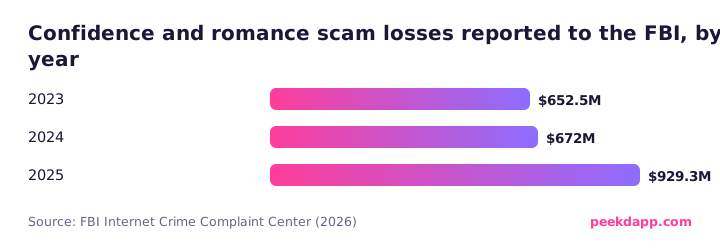
Chart data and embed code
| Value | |
|---|---|
| 2023 | $652.5M |
| 2024 | $672M |
| 2025 | $929.3M |
<a href="https://www.peekdapp.com/cheating-statistics/#chart-romance-scam-losses"><img src="https://www.peekdapp.com/assets/stats/cheating-statistics/romance-scam-losses.svg" alt="Confidence and romance scam losses reported to the FBI, by year" width="720" height="248" style="max-width:100%;height:auto" /></a>
<p>Source: <a href="https://www.peekdapp.com/cheating-statistics/">Cheating Statistics 2026: Infidelity, Phones and Social Media</a> (Peekd)</p>Stalking, stalkerware and digital abuse
80% of US stalking victims were stalked using technology, such as unwanted calls, texts, messages or tracking. (Source: US Bureau of Justice Statistics, 2022)
There is a line between noticing what a partner posts publicly and monitoring them. Secretly installing tracking apps, reading private messages or logging into someone’s accounts is abusive, and in many places illegal.
- # 80% of US stalking victims were stalked using technology, such as unwanted calls, texts, messages or tracking. (Source: US Bureau of Justice Statistics, 2022; US residents 16+, 2019)
- # About 3.4 million US residents aged 16 or older (1.3%) were stalked in 2019. (Source: US Bureau of Justice Statistics, 2022; US residents 16+, 2019)
- # Of victims stalked with technology, about 32% were monitored through social media, 22% were spied on with technology and 14% were tracked with an electronic device or app. (Source: US Bureau of Justice Statistics, 2022; US residents 16+, 2019)
- # Victims of both traditional and technology-based stalking were more likely to be stalked by an intimate partner (35%) than victims of only traditional stalking (11%). (Source: US Bureau of Justice Statistics, 2022; US residents 16+, 2019)
- # 22.5% of US women (28.8 million) and 9.7% of men (11.9 million) have experienced stalking in their lifetime. (Source: CDC, National Intimate Partner and Sexual Violence Survey, 2025; 15,609 US adults, 2023–24)
- # Among US stalking victims, 20.1% of women and 25.0% of men were monitored through software, apps or other stalkerware without permission. (Source: CDC, National Intimate Partner and Sexual Violence Survey, 2025; 15,609 US adults, 2023–24)
- # Among US stalking victims, 15.6% of women and 29.3% of men were tracked with GPS. (Source: CDC, National Intimate Partner and Sexual Violence Survey, 2025; 15,609 US adults, 2023–24)
- # 12.2% of US women and 4.2% of men have been stalked by an intimate partner. (Source: CDC, National Intimate Partner and Sexual Violence Survey, 2025; 15,609 US adults, 2023–24)
- # Kaspersky found stalkerware on the devices of 31,031 of its users in 2023, up from 29,312 in 2022. (Source: Kaspersky, State of Stalkerware, 2024; Kaspersky mobile users)
- # More than 34,000 Kaspersky users were affected by stalkerware in 2024–25, and 45.7% of adults surveyed in 19 countries had experienced tech-enabled abuse in the past year. (Source: Kaspersky, 2026; 7,600 adults in 19 countries)
- # 28.1% of US teens who had been in a romantic relationship in the previous year experienced digital dating abuse: 32.3% of boys and 23.6% of girls. (Source: Hinduja & Patchin, Journal of Interpersonal Violence, 2021; 2,218 US students aged 12–17)
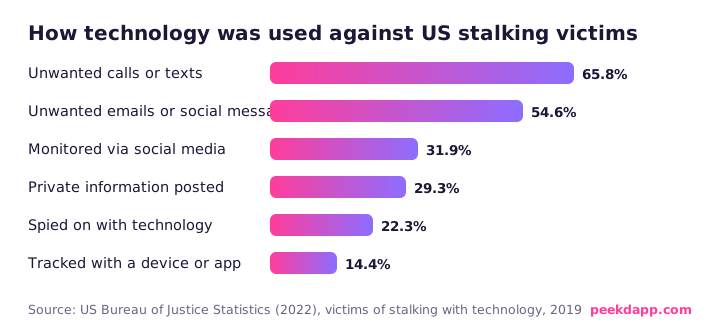
Chart data and embed code
| Value | |
|---|---|
| Unwanted calls or texts | 65.8% |
| Unwanted emails or social messages | 54.6% |
| Monitored via social media | 31.9% |
| Private information posted | 29.3% |
| Spied on with technology | 22.3% |
| Tracked with a device or app | 14.4% |
<a href="https://www.peekdapp.com/cheating-statistics/#chart-tech-stalking"><img src="https://www.peekdapp.com/assets/stats/cheating-statistics/tech-stalking.svg" alt="How technology was used against US stalking victims" width="720" height="336" style="max-width:100%;height:auto" /></a>
<p>Source: <a href="https://www.peekdapp.com/cheating-statistics/">Cheating Statistics 2026: Infidelity, Phones and Social Media</a> (Peekd)</p>How we chose these statistics
- Original sources only. Every statistic links to the organisation that collected the data or to the published study. We don’t cite statistics aggregators, and we left out widely shared numbers we couldn’t trace to an original.
- Checked by hand. Each source page was opened to confirm it is live and states the number as we report it. Where only an abstract or a university summary was available, the source line says so.
- Dates and samples shown. The year next to each statistic is the publication year; the sample is shown where the source gives one. Older research is included when nothing newer exists and is labelled with its year.
- Links, not causes. Studies that compare social media use with breakups or divorce are correlational. We describe them as links, not causes.
- Kept current. We add new research as it is published and log every change below. If you spot an error or a newer source, tell us.
About Peekd
Peekd is an Instagram follower tracker made by Reelpop. It records when a public Instagram account follows or unfollows someone, with the date it first saw the change. It can’t see DMs, likes, private accounts or anything from before tracking starts, and it never asks for anyone’s password. The statistics on this page come from the independent research linked next to each number, not from Peekd’s own data.
If what worries you is a pattern of follows and unfollows, our guide to signs of cheating on Instagram explains what those signals can and can’t tell you, and the follower tracker shows how tracking works.
How to cite these statistics
You are welcome to quote any statistic on this page. Please cite the original source shown next to it, and link to this page if it is where you found it. Every statistic and chart has its own link: use the # next to a statistic, or the chart's embed code.
Citation (APA): Peekd. (2026). Cheating Statistics 2026: Infidelity, Phones and Social Media. https://www.peekdapp.com/cheating-statistics/
HTML link: <a href="https://www.peekdapp.com/cheating-statistics/">Cheating Statistics 2026: Infidelity, Phones and Social Media</a> (Peekd, 2026)
Update log
- 2026-11-19: First version published.
Frequently asked questions
How common is cheating?
In the US General Social Survey, 20% of ever-married men and 13% of ever-married women say they have had sex with someone other than their spouse. Counting emotional cheating and unmarried relationships, 33% of Americans who have been in a monogamous relationship say they have cheated (YouGov, 2022).
What percentage of marriages have infidelity?
There is no direct count of marriages; surveys ask individuals. In 2021–22, 13% of ever-married Americans aged 25–54 said they had had sex with someone other than their spouse. Counting emotional affairs too, 22% of ever-married Americans report an emotional affair, a sexual affair or both (Institute for Family Studies).
Who cheats more, men or women?
Overall, men: 20% of ever-married men vs 13% of women report extramarital sex. The gap has closed among younger adults, where women are slightly more likely to report it (11% vs 10% of those aged 18–29).
Is emotional cheating more common than physical cheating?
They are now about as common. In a 2026 YouGov survey, 18% of Britons who had been in a relationship admitted emotional cheating and 17% sexual cheating.
Do most couples break up after cheating?
Many do but not all. About half of prime-age Americans who cheated on a spouse are divorced or separated, and about 3 in 4 people who were cheated on ended the relationship, but 39% of those later got back together (YouGov, 2022).
Does social media cause divorce?
Research shows a link, not proof of cause. Heavier Facebook use is associated with higher divorce rates and more relationship conflict, and 97% of top US divorce lawyers have seen more evidence taken from smartphones, but the studies can’t show that social media itself ends marriages.
Keep exploring
More guides
How to download your Instagram data · Instagram activity status · Best Instagram tracker apps · Did someone block you? · Instagram following limit · Following list order · Ghostdroid tested · Hide followers and following · Why am I losing followers? · Who viewed my profile? · See who someone recently followed · Remove followers · Did someone restrict you? · Story screenshot notifications · See what someone likes · Instagram stalker apps · Story viewer order explained · Unfollow people who don’t follow back

Social media, jealousy and conflict
23% of partnered US adults whose partner uses social media have felt jealous or unsure about their relationship because of how their partner interacts with other people there. (Source: Pew Research Center, 2020)
Social media makes a partner’s interactions with other people visible, and that visibility causes friction, especially for younger and unmarried couples. The studies linking platform use to breakups are correlational: they show a link, not that social media causes the breakup.
Chart data and embed code
Embed this chart (it links back to this page):